
Writing with Birds
It's fledgling season

I’ve been preoccupied with owls and crows.
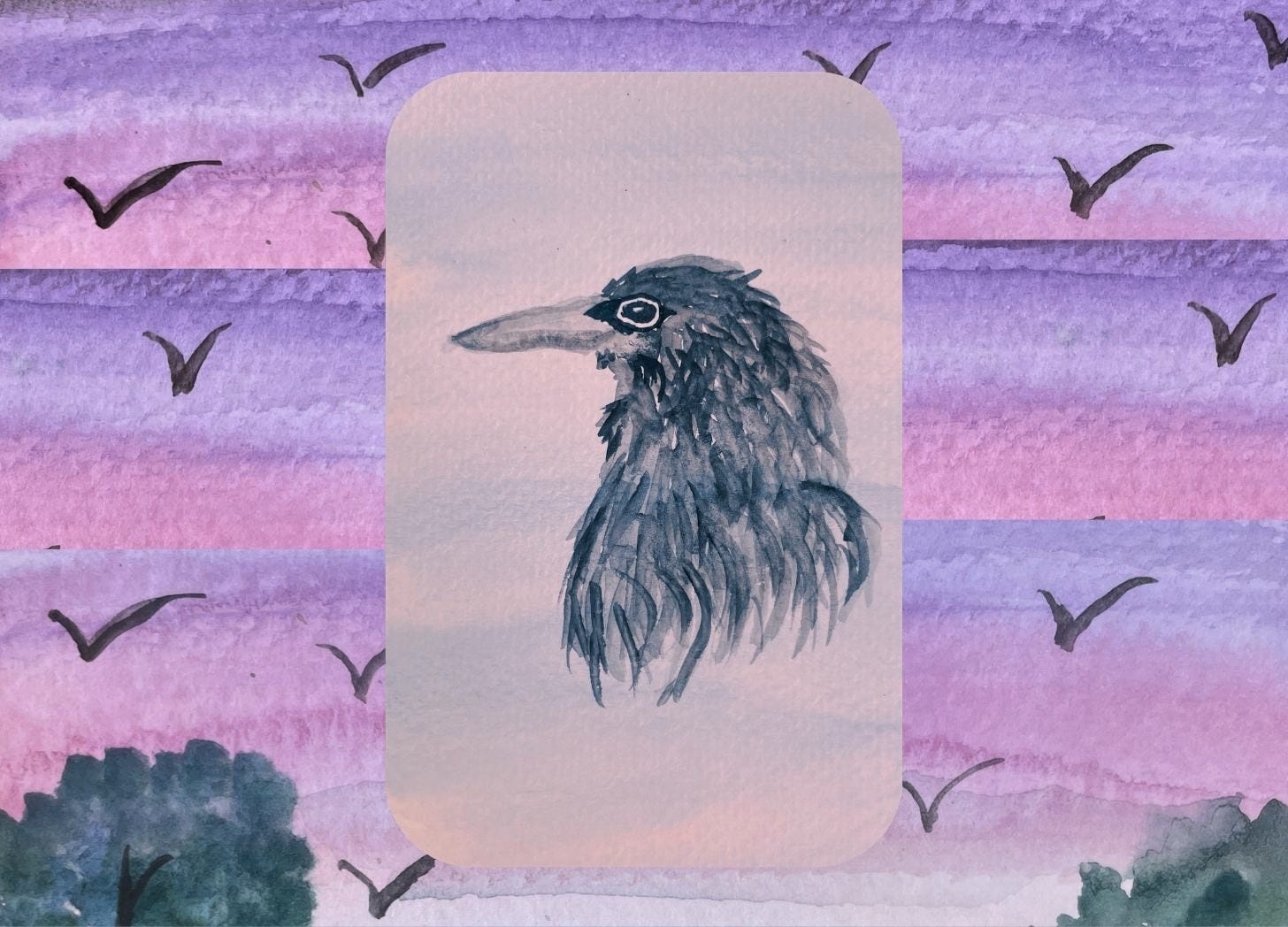
Earlier in the spring, I saw two fledgling owls and their mother standing guard in a nearby tree. It was an uncanny sight. Owls always feel to me like they exist in a different current of time. The clock seems to slow in their presence. I’d never seen baby owls before, but these two, tucked into their nest, poking their heads up, looked curious and adorable – like muppets, I thought, my mind grasping for anything I knew to compare them to. And the mother stared us down as we watched, stared me down. I was sure, as I gazed at her through binoculars, that she was looking right back at me, right back into me.
I struggle, even here, to find words to describe owls. I have never really known how to write with them. They seem birds of an otherworld.
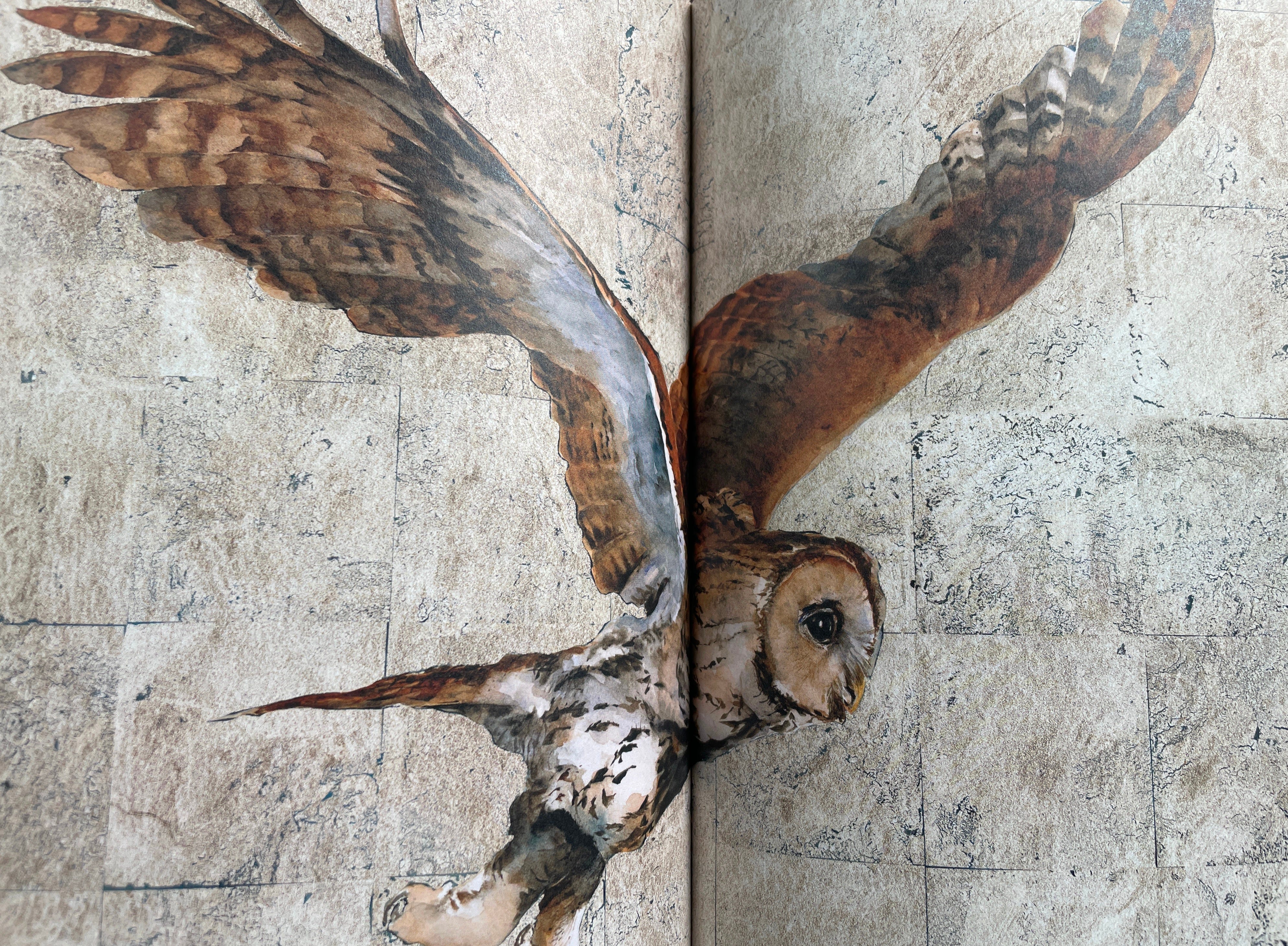
In The Book of Birds, Robert MacFarlane describes the owl as watching with eyes of “just pure night”
“Owl lives on the other side of silence. Owl’s ears hear noise glistening from every angle, in every nook. Owl’s ears turn darkness into day, landscape into book.”
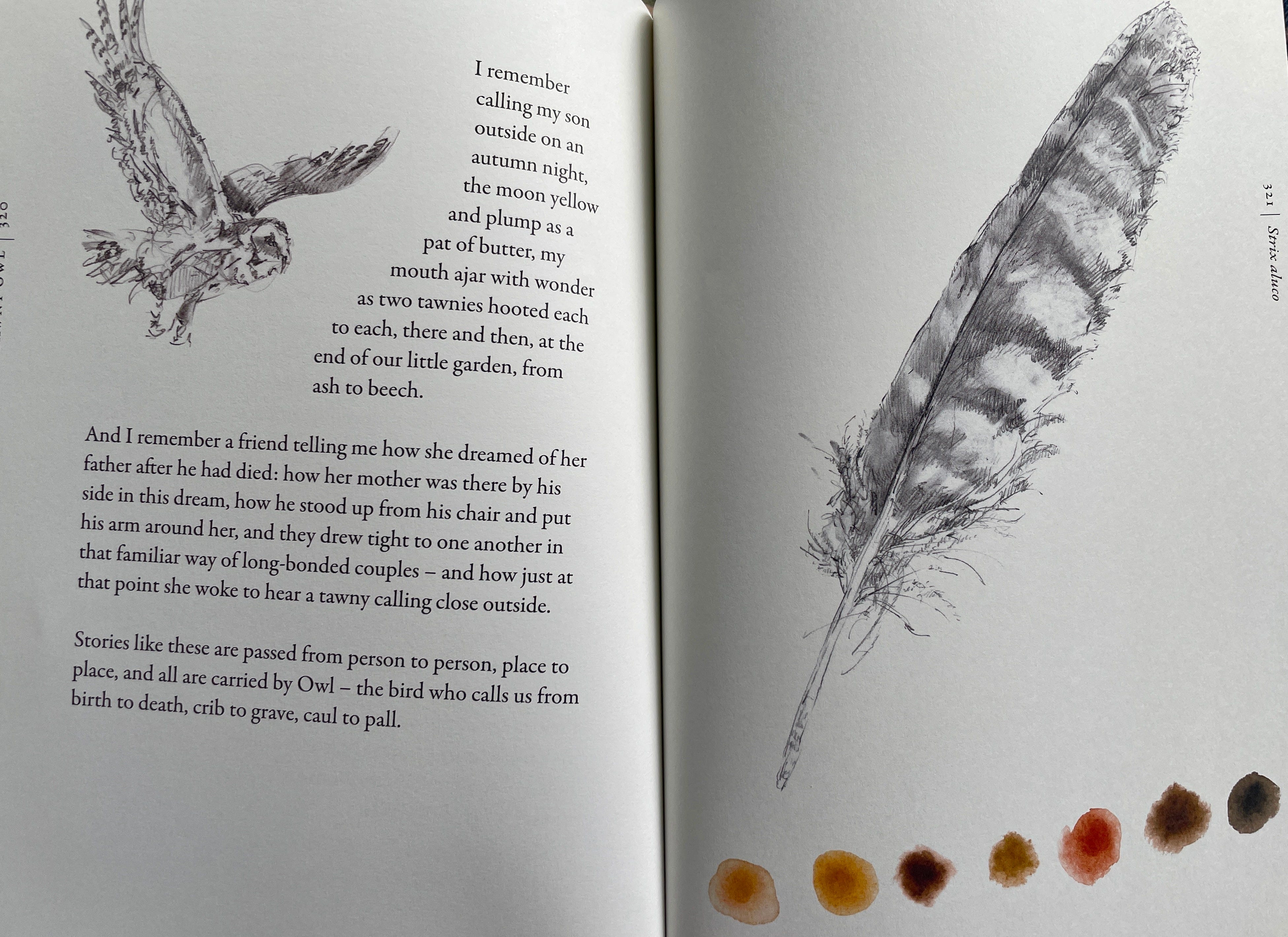
The Book of Birds, a new collaboration from Robert MacFarlane and Jackie Morris, is a gorgeous volume. Inspired by field guides it sets out to ask:
“…not ‘What is that bird?’, but ‘Who is that bird?’ It wishes to help its reader to identify birds, of course, but also to identify with them. Instead of photographs – paint. Alongside data – metaphor, story, poetry. In place of definition – relation. As well as classification – something like love.”
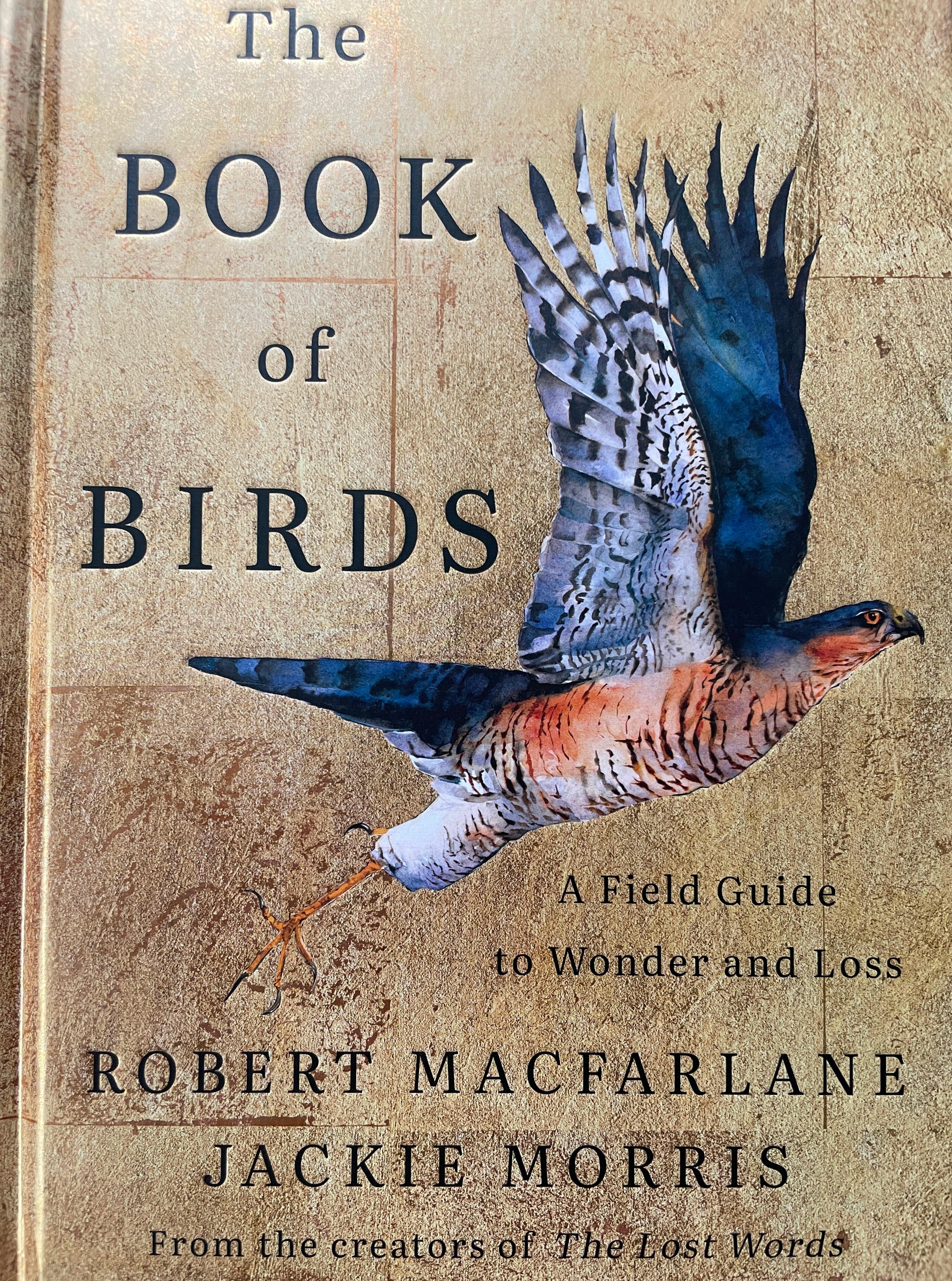
This isn’t the first time Jackie Morris and Robert MacFarlane have collaborated to bring us into the love of the more-than-human. Their books The Lost Words and The Lost Spells are beloved tributes to the natural world, evoking the spirits of species, spelling them into our human awareness with poems and paintings.
These are books that reach toward the more-than-human, evoking, through the imperfectly human languages of words and paints, the nonhuman in their pages.
As I’m reading this new book, I’m also dodging my neighborhood crows. It’s fledgling season which, for humans in Portland, means its the season of divebombing. It can be hard to see where the season’s new crows are wandering, still getting used to their wings, but the parents are all standing guard, ready to defend them from every squirrel, cat, and clueless human passerby.
Portland is a city known for its massive crow population. In this season, I alter my walking routes. I stay to the main roads. I avoid veering through my usual quiet byways where there are fewer cars and, therefore, likely more baby birds. I keep my ears attuned to the particular caw of the defensive parent—you can distinguish it if you listen, that specific mix of frantic and immovable, the caw that says “I will kill you if you come near my child” and “I am so overwhelmed by keeping this wandering fearless feathery creature safe in this big and terrifying world. My heart is careening around outside my chest and everything is trying to eat it. Please, please just leave us in peace, I beg you.” Each year, I am chased away by at least one desperate crow parent. It is a tense season.
Now crows, I can write about. They have long been a part of my daily interactions. Whether passing them as they go about their crow business or being tailed by them as I go about my human, I know crows and they know me. We are still both ways mysterious, but we are familiars to each other.
A Spell to Write with Birds
Be with your chosen bird. Become familiar. If you can, be with them in time and space. Research can also be helpful – growing your understanding of the species from scientific and folkloric perspectives – but observation and sharing space with the bird you would like to write with may prove the most helpful.
As you write, consider the following:
Sound: What sounds does the bird make? Their calls, chirps, flutters, how do they feel to you? What do you think of when you hear them? Do they remind you of words? The sounds of letters? Use these as you write.
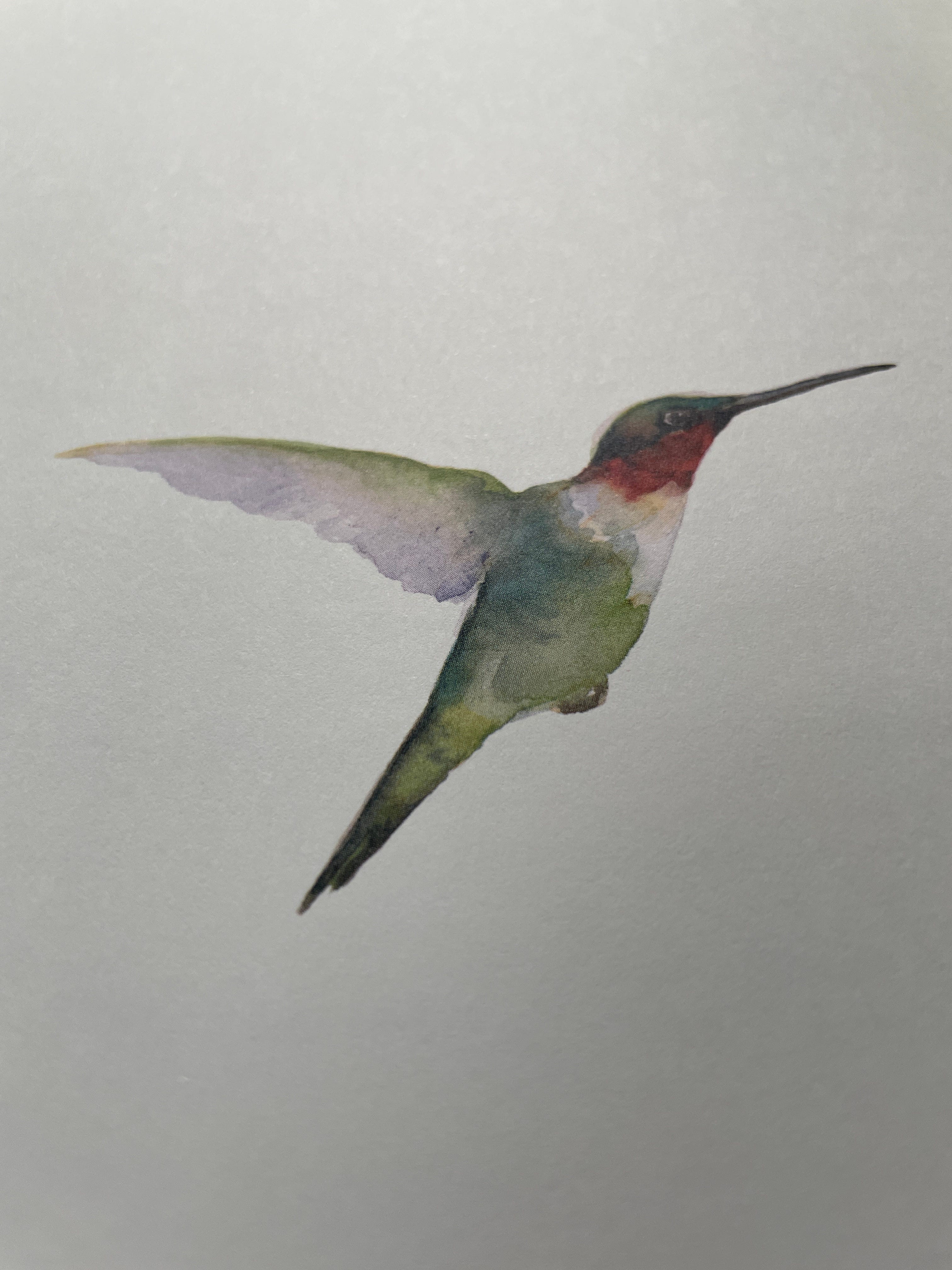
Rhythm: What pace does the bird move at? Are they fast like a hummingbird? Slow and out-of-time feeling like an owl? Are they skittery like a chickadee? Focused as a hawk? Do they flap their wings quickly or soar? Do they hop, perch, watch, crane, dive? All of these? How can you speak to or with these rhythms through the cadence of your words and lines?
Form: What shapes and forms do you associate with this bird? You might consider flight patterns, nest shapes, wings and feathers – the V of a flock of geese flying, the hover of a humming bird – anything you can put a form to. Experiment with how your writing can be inspired by or mimic this form.
You might write about the bird you choose or about another subject entirely. The purpose of this exercise is to allow your chosen bird to inform how you craft your piece.
Happenings
I am teaching two online courses starting in early July:
The First 10 Pages: A Revision Workshop
Hone the first ten pages of your fiction or nonfiction manuscript. We’ll revise twice over the course of these six weeks so you get those pages really dialed in. Begins July 7.
Writing with Plants, Animals, and Ecosystems
Write six new pieces in six weeks as we explore techniques for writing with the more-than-human. Short optional readings. No homework. Just generative writing. Begins July 6.
Come join us online!
Happy Writing.
I love this. And I loved Is A River Alive so thank you for turning me onto this next book too.
I love all of this! 🪶